
Water4All Educational Toolkits
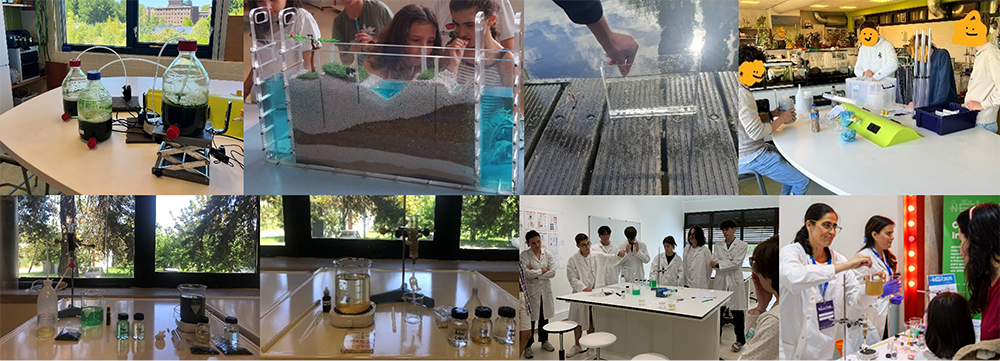
The Water4All educational toolkits are hands-on experimental kits that allow students to conduct their own experiments, encouraging active learning, reflection, and curiosity. Designed for secondary and high-school students, the toolkits target young people at a stage when they begin to explore science and consider future career paths. Water4All aims to introduce key water challenges early, nurturing scientific curiosity and awareness of water-related issues that are critical for society.
Each toolkit is aligned with the Water4All Strategic Research and Innovation Agenda (SRIA), highlighting priority water challenges that are relevant for both current and future generations.
Manual & Guideline
Each toolkit is accompanied by clear manuals and guidelines for both students and teachers. These materials provide the necessary background and step-by-step instructions, enabling independent use of the toolkits and supporting effective learning inside and outside the classroom.
Development, testing & dissemination
Five Water4All partners developed educational toolkits within their own institutes, which were first tested locally and then disseminated to students through their respective networks. In total, eight educational toolkits were developed under Water4All (click to expand):
-
Algae: The gold green
The toolkit introduces the concept of removing and recovering valuable resources from water, such as phosphate, before they cause environmental problems. It highlights the link between water contamination challenges and the opportunity to turn pollutants into resources for other purposes, for example through the use of algae.
SRIA: I. Water for circular economy: smart water value
Developed by: Wetsus
-
Climate change
The toolkit demonstrates the effects of rising temperatures on the atmosphere, illustrating potential changes due to worsening climate change and encouraging students to reflect on these impacts.
SRIA: II. Water for ecosystems and biodiversity
Developed by: UÉvora
-
Experiments in hydrogeology
The toolkit introduces basic concepts in geology, hydrogeology, and hydrology, visualizing subsurface layers to help students understand groundwater flow and river–groundwater interactions.
SRIA: III. Water for the Future: Sustainable Water Management
Developed by: BRGM
-
Shape your soil
The toolkit demonstrates the connection between soil and water by showing how different soil types have varying water retention capacities, which are directly linked to drought resilience, soil health, and agricultural productivity.
SRIA: III. Water for the future: sustainable water management
Developed by: Wetsus
-
Vegetation and nature-based solutions (NBS)
The toolkit illustrates the role of vegetation in preventing soil erosion and demonstrates how plants help stabilize the landscape. It also highlights the broader environmental benefits of vegetation, including supporting biodiversity, and contributing to sustainable land and water management.
SRIA: II. Water for ecosystems and biodiversity
Developed by: UÉvora
-
Water treatment – Conventional process
The toolkit demonstrates conventional water treatment processes, such as coagulation, flocculation, sedimentation, and sand filtration, used to remove turbidity from water. It helps the students to understand a common water contaminant.
SRIA: IV. Water and Health
Developed by: LNEC
-
Water treatment – Advanced process
The toolkit demonstrates advanced water treatment processes for removing emerging contaminants, such as color and micropollutants, using adsorption with activated carbon or membrane filtration. It helps the students to further understand other types of challenging water contaminants and how to remove them.
SRIA: IV. Water and Health
Developed by: LNEC
-
Water quality toolkits
The toolkit introduces basic tools for assessing water quality, including the investigation of physical, chemical, and (micro)biological contaminants. It also encourages a critical view of water quality in our environment.
SRIA: IV. Water and Health
Developed by: CIV-Water