

The event, held in Montpellier on April 9–10, 2025, brought together coordinators, experts, funding agencies, and sister initiatives to generate synergies around Water4All and strengthen Europe's commitment to water research, innovation, and sustainability.
The city of Montpellier in France hosted the kick-off meeting of the 23 projects funded under the 2023 Joint Transnational Call on Aquatic Ecosystem Services, launched by the Water4All European Partnership. The event was organised by the French National Research Agency (ANR) with the collaboration of the Spanish State Research Agency (AEI). It brought together project coordinators, institutional representatives, scientific experts, and stakeholders from Water4All and related initiatives such as Biodiversa+, making it a key forum for advancing European cooperation in sustainable water management.
Main Event – April 10: Project Presentations and Follow-up Group Involvement
The main plenary session took place on April 10. Throughout the day, coordinators of the 23 funded projects presented their aims, methodologies and expected impacts in parallel sessions moderated by members of the Follow-up Group.
AEI, as Follow-Up Secretariat, played a significant role in this process by identifying and inviting eight renowned international experts in the relevant thematic areas to join the Follow-up Group. These experts provided valuable feedback and strategic guidance, ensuring a high-quality scientific foundation for all projects from the outset. They will accompany the development of the projects over the three-year duration, providing formal feedback to the coordinators during the mid-term and final evaluation seminars.
Booklet of the funded projects: Link here
____
Parallel Events – April 9: Field Visit and Knowledge Hub Launch
The programme began on April 9 with a technical visit to a BRGM (Bureau de Recherches Géologiques et Minières) research site in the Montpellier area, where pilot projects focused on Nature-based Solutions (NbS) were presented. This was followed in the afternoon by the official launch of the Water4All Knowledge Hub on Aquatic Ecosystem Services. The session featured interactive discussions based on causal loop mapping and was closed to the public, gathering the funded project teams to foster a shared understanding of key challenges facing aquatic ecosystems in Europe.
Field visit: water springThe meeting took place in the south of France in Montpellier where the participants could visit the “source du Lez”. The drinking water that supplies this city comes from a remarkable karst aquifer that forms the River Lez. 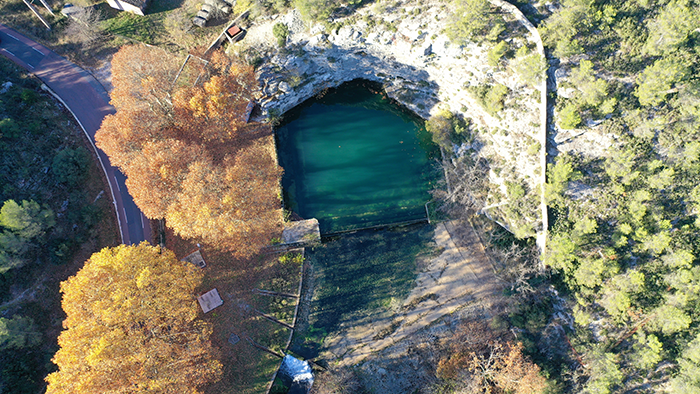
This water resource is of high quality due to the geological configuration of the site, and has also allowed the economic development of the city. Karst aquifers are important ground water resource that help meeting the increasing water demand, especially when the population is growing (here in the Mediterranean region of Montpellier). An “active management” allows an optimum use of this water resource. The groundwater monitoring indicates that after the drop of summer water level, the Lez spring rises each autumn, demonstrating that the aquifer exploitation is inferior or in balance with the renewable resource. However climatic changes or increasing water withdrawal may affect the hydrological cycle of the Lez aquifer. Thus, to determine these (possible) impacts, a numerical modelling has been set up in order to prevent and preserve water balance and ecosystem services. The Lez spring which is the main outlet of the karst aquifer, is located in the north of Montpellier and provides different aquatic ecosystem services:
The Chabot, a unique fish The Lez river is home to an endemic fish species named “the Chabot”, a small fish, sensitive to hydrological fluctuations and water quality. It can only be found in the Lez river; the area and the Chabot being both protected. The Lez spring is, therefore, a hydrologic object at the interface between groundwater and surface waters, which supports an important aquatic ecosystem fully dependant on the upstream aquifer. |
Knowledge Hub activityBuilding Bridges for Aquatic Ecosystems: Highlights from the Knowledge Hub Launch Event (9 April 2025, Montpellier) On April 9th, 2025, the 2-day kick-off hosted the launch event for the Water4All Knowledge Hub on Aquatic Ecosystem Services (AES), a cornerstone initiative under the partnership. The event marked the "first impact session of the knowledge hub," bringing together more than 20 dedicated Water4All researchers from across the field. The day was planned to initiate collaboration and deepen systematic understanding on the factors that are effecting the AES. Attendees began by dividing into subgroups to tackle a vital question: how have the key properties of aquatic ecosystem services evolved over both shorter and longer periods? This exercise encouraged participants to analyze changes and explore their interconnections within various contexts and sub-ecosystems. It was a dynamic session that highlighted the diverse challenges researchers face in their respective fields. After engaging in subgroup discussions, the researchers reconvened to delve into broader trends AES. Using causal loop diagrams, they collectively worked to map and elaborate on the main drivers and their interdependencies. This approach not only helped visualize complex relationships but also provided a platform for shared insights and innovative thinking. The launch event set a strong foundation for the Knowledge Hub, creating a space for interdisciplinary dialogue and a unified approach to advancing the study and management of aquatic ecosystem services. As the first impact session, it underscored the importance of collaboration and systems thinking in tackling the pressing challenges facing our water ecosystems today. Link to more information: here |
TAP Action AQUA-WISE Cluster WorkshopA parallel session during the Water4All kick-off meeting was included. The AQUA-WISE cluster meeting brought together 13 representatives from 8 participating projects across 4 countries. It was a moment to showcase the cluster´s objectives, collaborative efforts, the process of finding links and common ground between the different projects. TAP Action is an additional call by the partnership aiming to elevate the impact of nationally funded research by providing a unique opportunity for projects to network and collaborate internationally on specific research topic. By enabling such cross-border cooperation, the TAP Action increases the impact and leverage effects of these projects. Learn more on this activity running since January 2024 link here |


